Case Study · Enterprise · Automotive
Redesigning KBB's Highest-Traffic Valuation Experience
As UX Lead at Kelley Blue Book, I drove the redesign of the Owner's Path - KBB's most critical revenue flow - migrating it onto the Orion Atomic Design System. The result: 92% traffic conversion, CSAT scores exceeding targets, and a project that inspired AutoTrader.com's own design system migration.

The business context
The Owner's Path valuation experience is KBB's primary revenue driver. Any redesign had to improve metrics without disrupting financial projections - a high-stakes constraint that shaped every decision.
The problem
KBB's Owner's Path had been steadily losing traffic to competitors. An independent analysis of all Cox Auto products confirmed that dated aesthetics, inconsistent UI patterns, and a non-responsive experience were driving users away.
Audience visits
Declining
~23M/mo with consistent decreases
CSAT scores
79% / 81%
Desktop / Mobile - below targets
Design system
Legacy ARGO
Outdated, non-responsive, slow to iterate
OKRs & success criteria
Cox had spent 18 months building the Orion Atomic Design System to modernize their properties. In addition to migrating to Orion, we set specific OKRs:
- Increase visits to the Owner's Path from Cox products by at least 10%
- Increase conversion to 3rd party products by 5%
- Raise CSAT - Desktop: 79% → 85% | Mobile: 81% → 85%
- Implement Orion without impacting financial projections
Analytics & research
I partnered with UX Research and the in-house analytics team to understand where users were struggling and where competitors were pulling traffic.
- Conducted user research to understand pain points and preferences
- Analyzed site traffic, conversion rates, and satisfaction data
- Confirmed Orion would reduce user friction at the Owner's Hub entry point
- Identified confusion with ICO (Instant Cash Offer) entry on the hub and YMMT flow
- Discovered massive user loss from ad and ad-blocker barriers to entry
HCD sessions & user testing
I facilitated Human-Centered Design workshops with stakeholders and end-users to validate assumptions, gather qualitative insights, and refine design directions before committing to development.
- Facilitated collaborative workshops with stakeholders and end-users
- Gathered insights and feedback to iteratively refine design solutions
- Conducted A/B testing to compare design variants
- Ran Controller/Challenger testing across Hub Mobile V1, Hub Desktop V1, and the Hub Final V2 to measure impact on user behavior before full release
From legacy ARGO to Orion
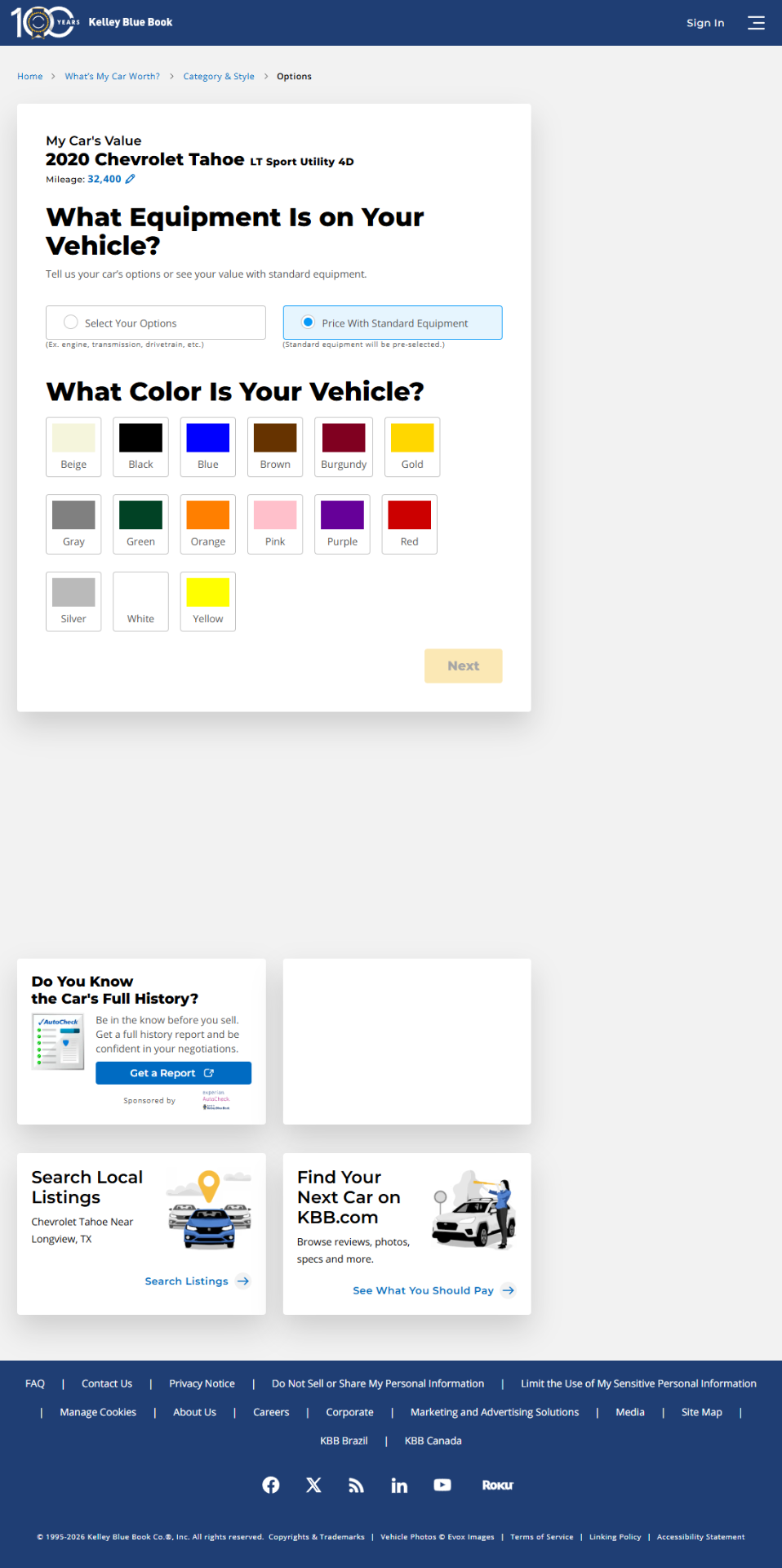
A core part of the work was translating older ARGO-based screens into Orion's componentized system while improving hierarchy, simplifying steps, and making the experience fully responsive - desktop and mobile sharing the same atoms, only changing density and orientation.
Wireframing & prototyping
Using user flows I'd created for UX reference, I built wireframes and hi-fi prototypes for each Orion-based valuation step. These were A/B tested against legacy ARGO equivalents and handed off with annotated specs so the engineering team could implement against a verified pattern rather than a static comp.
Results
The redesign delivered measurable impact within the first 4 weeks of deployment:
Traffic conversion
86% → 92%
Highest conversion of any Cox Auto product post-launch.
CSAT scores
85% / 87%
Desktop / Mobile - both exceeded targets (83% / 85%).
Broader impact
The success of this project on KBB.com directly informed the business case for migrating AutoTrader.com to the Orion Design System - a separate, larger initiative. Over my 7.5-year tenure, the UX-driven improvements I contributed to across KBB and Autotrader resulted in an additional $379 million in revenue and CSAT scores improving from 65% to 86% across the portfolio.
This project reinforced how to drive measurable outcomes within large cross-functional teams, work within design system constraints, and translate research and analytics into concrete UX improvements at enterprise scale.